
THE ARCHAEOLOGY OF
COLINGTON ISLAND
David Sutton phelps
with appendices
NON-FISH FAUNAL REMAINS
FROM THREE SITES ON COLINGTON ISLAND
Jeannette Runquist
FISH REMAINS FROM
THE COLINGTON ISLAND SITES
Camm C. Swift

ARCHAEOLOGICAL RESEARCH REPORT NO. 3
Archaeology Laboratory
Departrnent of Sociology and Anthropology
East Carolina University
Greenville, North Carolina
1981
i

 |
| TABLE OF CONTENTS | |
| Frontispiece (above) | ii |
| List of Figures (below) | iv |
| List of Tables (below) | v |
| Acknowledgments (below) | vi |
| Introduction | 1 |
| Archaeological
Sites on Colington Island
|
6 |
| Settlement and Subsistence on Colington Island: A Summary | 47 |
| Appendix
A. Non-fish Faunal Remains from Three Sites on Colington Island |
56 |
| Appendix B. Fish Remains from the Colington Island Sites | 72 |
| References Cited | 80 |
iii
iv
v
ACKNOWLEDGMENTS
In the summer of 1972, the Colington Harbour resort community was in the final stages of development by the American Central Corporation of Lansing, Michigan, and a relatively small number of lots had been sold to private owners. The author is most grateful for the permission granted to survey and excavate the sites controlled by the American Central Corporation, as well as the interest shown in the project by the local personnel of that corporation. The farewell party they hosted for our staff and students at the conclusion of our research was a memorable occasion and ample testimony to their cordial hospitality.
Appreciation is also expressed to the owners of those already developed private lots in the Colington Harbour community, and in other parts of the island, who readily gave permission for access to, and excavation of, their properties. The Colington Harbour community is now controlled by the Colington Harbour landowners association, whose representatives have been most cooperative in granting permission for access to the sites over the years since 1972. Numerous students in East Carolina University and UNC Sea Grant summer courses have thus visited the sites on field trips, and gained valuable experience from their observations.
The Dare County Board of Commissioners kindly permitted us to occupy three buildings of the former Auxiliary Naval Air Station at the Manteo Airport on Roanoke Island, which served as dormitory and laboratory space during the 1972 field school operation. Following our occupancy, that facility was demolished to provide a building site for the present North Carolina Marine Resources Center.
Numerous citizens of Dare County were most cooperative in providing information about sites and area history on Colington Island and elsewhere in the county. Such information is always welcome since it generally enhances the overall understanding of a locality necessary to successful completion of a project such as this.
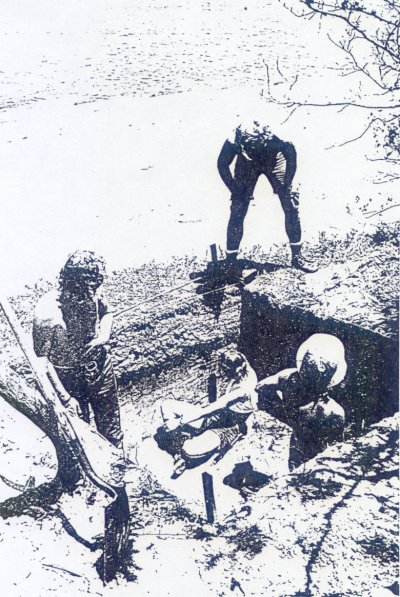
Henry Applewhite, photographer of Manteo, North Carolina, was responsible for the Frontispiece photograph taken along with many others while he followed our work that summer in conjunction with a publicity assignment.
The line drawings of artifacts in Figure 7 were done by Janice Northcutt, one of the 1972 field school students.
Final analysis and publication of the data from the 1972 Colington Island research was made possible through a Heritage Conservation and Recreation Service survey and planning grant to East Carolina University. The grant was administered through the Archaeology Branch, Division of Archives and History, North Carolina Department of Cultural Resources.
vi
Copyright  2002
2002
Carolina Algonkian Project, All Rights Reserved
 |
 |