Return |35th Inf| 36th Inf| 37th Inf| 37th Hist|14th Art| 135th | Navy| Histories| Service| Pensions| Letters| Medal| Poster |Search |Contact |Home

Return |35th Inf| 36th Inf| 37th Inf| 37th Hist|14th Art| 135th | Navy| Histories| Service| Pensions| Letters| Medal| Poster |Search |Contact |Home
Raising the African Brigade:
Early Black Recruitment in Civil War
North Carolina
by Dr. Richard Reid
(By Special Permission of the NC Division of Archives & History)
[Reprinted from North Carolina Historical Review, 70
(1993), pp. 266-301]
Part V
(289-293]
The Confederate propaganda notwithstanding, Wild was well aware of the real situation and the opportunity that it offered for his partially raised brigade. Filling the first two regiments, he later reported, had absorbed much of the available pool of black recruits in the Union-occupied areas. Civilian jobs had attracted many of the remaining candidates. Wild had not resorted to any form of impressment of blacks, although it was being ordered in Virginia at the time. Instructions had been sent from Washington to Fortress Monroe "to impress all able-bodied colored men for service in the Qr Masters Dept. at Washington." The result, George Stearns argued, was that the "ablest of them run for the woods imparting their fear to the slaves thus keeping them out of our lines, and we get only those who are too ignorant or indolent to take care of themselves. I feel sure we can get more men by fair enlistment." 102 Wild's refusal to compel recruitment may have resulted in more soldiers' signing up, or it may simply have allowed more black men to take civilian jobs with the various Union departments. For some refugees, the civilian jobs must have been more attractive than a soldier's pay of $10 a month and a chance of death offered by the army. Upon the occupation of New Been, General Burnside had established civilian pay scales that in many cases exceeded the soldiers' wages. Stevedores received $15 and teamsters $20 per month, while the day rates for carpenters, blacksmiths, masons, and mechanics ranged from $1.25 to $3.00. Even laborers were paid $10 a month, the same wages as soldiers but without the danger. In New Bern alone more than fifteen hundred black civilians were employed by November 1863. 103 The pay rates gave the quartermaster's, commissaries', engineer's, and other departments an advantage over what Wild could offer.
While black civilian occupation did not represent an absolute loss to the Union war effort but rather a redistribution of resources, it did force Wild to consider new ways to find further recruits in order to raise all four regiments envisioned. As a result, he planned in the summer of 1863 to conduct expeditions with his troops into Confederate counties, "each one of which would have brought us hundreds of recruits." 104 To do that he needed the Fifty-fifth Massachusetts, and its delay in arriving set back his plans. 105 As soon as the regiment arrived, the general gave instructions for a planned new raid. Before the expeditions could be launched, however, Wild was ordered to leave immediately with all available troops for Charleston, South Carolina. On July 30, less than six days after the arrival of the Massachusetts regiment, Wild and more than two thousand soldiers of the African Brigade embarked for South Carolina. General Foster predicted that "they will do well and fight well under their fighting general." 106
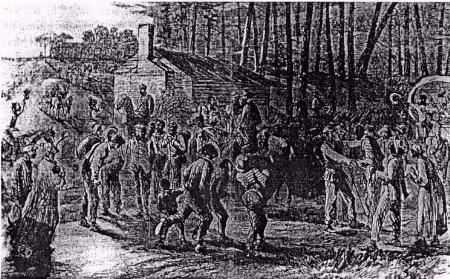
General Wild (center, on horseback) and troops of the African Brigade liberated slaves during a military operation in northeastern North Carolina in December 1863. Engraving from Harper's Weekly, January 23, 1864.
The brigade, in response to the unexpected orders, left in such haste that they took their arms and not much else. Knapsacks, camp equipage, officers' horses, baggage, and even the company books were all left at New Bern, and not until well into September could the regiments regain what had not been lost or stolen. 107 Wild had ordered things left at New Bern because he believed the transfer of his brigade to the new department to be merely temporary. 108 With that in mind, he integrated elements of the Second NCCV accompanying the brigade into the First NCCV. Those men would fill the vacancies created in the First NCCV because of sickness. The extra troops brought the brigade up to 2,150 men and forced the general to crowd more soldiers onto the transport vessels than had been expected. Although much was left behind, all guns and stretchers, plus hospital tents, were taken. 109
In many ways the move to South Carolina, which had been seen as a temporary response to a crisis, marked the end of the original experiment in raising and training a brigade of black North Carolinians under abolitionist guidance. After Wild left New Bern, recruitment of the Second NCCV slowed and delayed a start to the Third NCCV. Colonel Alonzo Draper, who had been left in charge of recruitment for the brigade, tried unsuccessfully to get authorization for "an expedition to bring in Colored recruits," and without that stimulus his efforts showed few results. 110 Enlistment picked up again in October and November only after Wild returned to New Bern, following his repeated protests that he was needed there to carry on recruitment of the third regiment. Within a month, however, he would be transferred to Fortress Monroe. 111 While Wild did conduct subsequent military operations within North Carolina in late 1863 from his base in Virginia, his ambitious plans for recruiting raids into interior counties were largely unfulfilled. Although the Third NCCV was ultimately formed, the fourth regiment of black infantry never materialized. Instead, a heavy artillery regiment was gradually mustered in from the freedmen in occupied North Carolina throughout 1864. 112
Wild did not stay in North Carolina in the fall because, well before his return from Charleston, all black troops had been ordered out of the state. On August 12, 1863, Major General John J. Peck, a West Point graduate and a New York Democrat, was given command of the District of North Carolina. 113 Within two weeks of Peck's arrival in the state, the remaining components of the African Brigade, Colonel Draper's Second NCCV plus a detached unit from the First NCCV, were informed that they were "destined (with all the other colored troops in NC) to Fortress Monroe." 114 Unlike the transfer of the First NCCV, this relocation was to be permanent. All of the property and the sick of Draper's command that could be moved must go. The move, in part, reflected Foster's fears that his base in Virginia was about to be attacked before his fortifications there were complete. 115 Since he was reluctant to ask for troops from either the Army of the Potomac or from Charleston, and since he wanted, first of all, a labor force, Draper's men served his purpose. At the same time, Peck appeared pleased to let them go. In his assessment of the defenses of North Carolina, Peck never regarded the African-American units highly. At the first intimation that black troops in his command would be relieved or replaced by white soldiers from Virginia, he sent them off even though it meant leaving some posts unguarded. 116 By the end of the year only white units were stationed in North Carolina. Additional black infantrymen would be mustered in by recruiting officers scattered in places such as New Bern, Roanoke Island, Plymouth, and Morehead City and then forwarded to the regiments in Virginia.
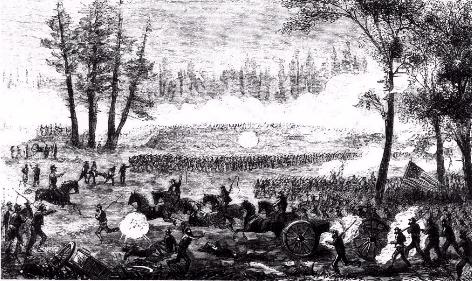
In February 1864 the Thirty-fifth United States Colored Troops (First North Carolina Colored Volunteers) fought in the Battle of Loustee, Florida, where Lieutenant Colonel William N. Reed was killed. Illustration of the engagement from Harper's New Monthly Magazine 33 (November 1866): 718.
Although Wild continued to command an "African Brigade" until April 1864, it was not what Governor Andrew had first proposed, a North Carolina black brigade. At Folly Island, South Carolina, in August 1863, the brigade consisted of the Fifty-fifth Massachusetts, the First NCCV, and the small detached part of the Second NCCV. 117 Four months later Wild's brigade, still called the African Brigade but now based in Norfolk, Virginia, contained the Second NCCV, the Third NCCV (only partly formed), the First Regiment United States Colored Troops (USCT), the Fifth USCT, and the Tenth USCT, plus two small and temporary detachments of the First NCCV and the Fifty-fifth Massachusetts.118 By April the general's brigade had been stripped of all North Carolinians. It then consisted of the First USCT, the Tenth USCT, and the Twenty-second USCT; the North Carolina regiments had been transferred to separate commands. The First NCCV had been sent to Florida in mid-February and would never serve with the other North Carolina regiments. Indeed, on February 8, 1864, the three regiments had lost their official designations as North Carolina soldiers and been renamed the Thirty-fifth United States Colored Troops, the Thirty-sixth United States Colored Troops, and the Thirty-seventh United States Colored Troops, respectively. 119 In official eyes, what made the African Brigade distinct and gave it cohesion was not the fact that all the soldiers were North Carolinians but rather that they were black and largely ex-slaves. Apparently there was no belief that the three Tar Heel regiments formed a natural entity, and even Wild indicated that he would fill his ranks "by picking up recruits by the wayside" wherever he might be located. 120 That attitude helps explain why, in an army in which white regiments retained their state designations and felt strongly about their state identifications, all black troops raised in the South became, in early 1864, merely numbered regiments of the United States Colored Troops. 121
Footnotes (102-121)
102. Maj. George L. Stearns to Hon. Edwin M. Stanton, August17,1863, Letters Received, Colored Troops Division, RG 94, printed in Berlin, Reidy, and Rowland, Black Military Experience, 100-101. Stearns indicated that impressment spread the same sense of fear throughout the black community whether the men were drafted as laborers or as soldiers.
103. At that time Maj. Gen. John Peck had complained that the high wages made it "impossible to make much headway with recruiting." Peck to Brig. Gen. I. Thomas, November 16,1863, enclosing Capt. R.C. Webster, "Report of Negroes employed by the Quartermaster's Department at Newberne N.C.," [November 2, 1863], Letters Received, Colored Troops Division, RG 94, printed in Berlin, Reidy, and Rowland, Black Military Experience, 133-134.
104. E.A. Wild. To Maj. Thomas M. Vincent, September 4,1863, Letters Received, ColoredTroops Division, RG 94.
105. The delay may have been the result of Stanton's unsuccessful suggestion to Governor Andrew that the Fifty-fifth Massachusetts be part of the force used in "relieving the troops at New Orleans and substituting for them troops of African descent." Official Records, ser. 3, 3:483.
106. Official Records, ser. 1, 28, pt. 2:30; "Military Life of Edward A. Wild," Massachusetts MOLLUS Collection.
107. Official Records, ser. 1, 28, pt. 2:96.
108. Maj. A. Bogle to F.W. Taggart, January 10, 1864, Descriptive Book, Thirty-sixth Regiment USCT, RG 94.
109. General Order No. 6, July 30,1863, Order Book, Thirty-fifth Regiment USCT, RG 94.
110. Alonzo G. Draper, Compiled Military Service Records, RG 94.
111. Alonzo G. Draper, Compiled Military Service Records, RC 94; Official Records, ser. 1, 28, Pt. 2:290, 412.
112. The first company of the First Regiment Heavy Artillery (African Descent) was mustered in at New Bern in March 1864, while the last company was completed in April 1865, by which time the regiment bore the name Fourteenth United States Colored Heavy Artillery. Throughout that period a swarm of out-of-state recruiters attempted to raise at least nine different regiments. Official Records, ser. 1, 33:870-871; Frederick H. Dyer, A Compendium of the War of the Rebellion (Des Moines, Iowa: Dyer Publishing Co., 1908; New York: Thomas Yoseloff, 1959), 1722.
113. Official Records, ser. 1, 29, Pt. 2:36, 81-82.
114. General Order No. 8. August 28,1863; Major General Peck to Colonel Draper, August 29,1863; Asst. Adj. Gen. J.A. Judson to Colonel Draper, August 29, 1863, all in Letter, Endorsement, and Order Book, Thirty-sixth Regiment USCT, RG 94.
115. Gen.John G. Foster had assumed command of the Department of Virginia and North Carolina. Official Records, ser. 1, 29, Pt. 2:87-88, 99.
116. Official Records, ser. 1, 29, Pt. 2: 165.
117. Also attached to the brigade was an independent company under Capt. John Wilder, which was briefly attributed to the Third NCCV. Official Records, ser. 1, 28, pt. 2:75.
118. Official Records, ser. 1, 29, pt. 2:619. At this time the Fifty-fifth Massachusetts and the First NCCV were still stationed at Folly Island, soon to be sent to Florida.
119. Dyer, Compendium of the War of the Rebellion, 1729-1730.
120. Gen. E.A. Wild to Maj. Thomas M. Vincent, June 25, 1863, Letters Received, Colored Troops Division, RG 94.
121. By contrast, the white Union troops raised in North Carolina retained their state designation. It is true that the Federal government, as the war progressed, tried to move toward the direct Federal enlistment of volunteers in other areas such as the Veteran Reserve Corps. Nevertheless, the difference in treatment of the white and black North Carolina regiments is very revealing. For a discussion of Federal attitudes on this issue see Russell F. Weigley, History of the United States Army (New York: Macmillan, 1967; Bloomington: Indiana University Press, 1984), 213-216.
©2009 to present by the NCGenWeb Project
NCGenWeb Military Project: U.S. Colored Troops