Behind the Legend of Currituck Jack


Caleb White and his half-brother Samuel Jasper were seafaring slaveholders at the time of the American Revolution. The two could not have anticipated that they would be remembered today primarily for the roles they played in the life of a Black man. To understand the siblings’ relationship to the man known in popular legend as Currituck Jack, some context is required.
The White family of Knott’s Island in northeast North Carolina had been slaveholders since their arrival there a century before the revolution. Henry White Sr, a grandson of the North Carolina family progenitor, served as a Currituck County representative in North Carolina’s legislature in 1731 and again in 1743, 1744, and 1746.[1] Among his bequests in his 1751 will, he left his son Henry “one negro man named Jack.” [2]
Henry White’s namesake son followed in his father’s footsteps as a politician, representing his county at five sessions of colony’s legislature.[3] He was also active in commercial shipping, engaging in trade from New England to the Caribbean. In March 1769, "George May of Greate Egg Harbor" in New Jersey signed a power-of-attorney appointing "Henry White of Currituck County" to collect sums due May.[4]
Deeds indicate Henry White lived in proximity to Caleb White and Samuel Jasper on Knott’s Island.[5] Although his relationship to them is unclear, the three were close associates. [6] Caleb and Samuel were sons of a twice-widowed woman named Dorcas, who had apparently wedded a member of the White family prior to bringing two children from that union with her into a marriage with Thomas Jasper. [7] In his 1763 will (witnessed by Henry White), Thomas Jasper left his wife the entirety of his estate “during her widowhood.” Thomas further directed that, once Dorcas married again or passed away, his property be equally divided between Samuel Jasper, Caleb White, and Lydia White.[8]
Dorcas Jasper’s children were still young when she was widowed for a second time; they would live with her for at least another decade. She is identified as their guardian in a 1770 Edenton, North Carolina court case titled White and White by Guardian vs. White. [9] Sadly, all that remains of that lawsuit today is a court summons that does not shed light on the nature of the dispute.
“Mrs. Jasper” was a regular at John Cockton’s store in the town of Currituck Courthouse before and after the Revolutionary War. She purchased a variety of cloth, thread, ribbon, buckles, and buttons there between 1772 and 1783, presumably to make her family clothes. She also bought peas and corn by the bushel, black pepper, aprons, stockings, bowls, a teapot, and a prayer book. She would sometimes send one of her children to retrieve the items she had ordered – Caleb White, Lydia White, and Samuel Jasper are each recorded as having separately done so. She once sent someone identified only as Tony, who was apparently enslaved. [10]
A tax list compiled in 1779, while the Revolutionary War was underway, shows Dorcas Jasper as a head-of-household with property worth £2,183. That placed her in the upper third of Currituck County residents in terms of net worth, but nowhere near the wealthiest locals. Henry White’s assessed value was, for example, £12,130.[11]
There were frequent loyalist raids along the Currituck Sound during the early years of the war, prompting locals to appeal to North Carolina’s revolutionary government for assistance.[12] Privateers landed on Knott’s Island during some of those incursions, taking livestock and sailing vessels.[13] The local White and Jasper families lived in the shadow of those raids, but the impact on them is unknown.
In February 1780, Caleb White set out on a trading voyage to the Caribbean as the captain of the schooner Polly. Sailing with him were his brother Samuel Jasper and the enslaved man known as Jack. Henry White, who was not aboard the Polly when it set sail, was a part owner of the vessel, and also Jack’s master.[14]
Like their free counterparts, the enslaved population of colonial Currituck County included skilled mariners. Local people of color were widely engaged in shipbuilding, fishing, and seaborne trade. Coastal slaveholders commonly relied on, and profited from, the nautical expertise of those bound to them.
Schooners, typically manned by a crew of three or four, were lighter than most cargo ships and well suited to navigating the shallow waters that separated North Carolina’s mainland from its Outer Banks. Such two-masted vessels operated along coastlines, as they were not generally considered sturdy enough for transatlantic travel.[15] In a sworn statement years later, Samuel Jasper described a fateful trip that he, Caleb White, and Jack undertook in 1780:
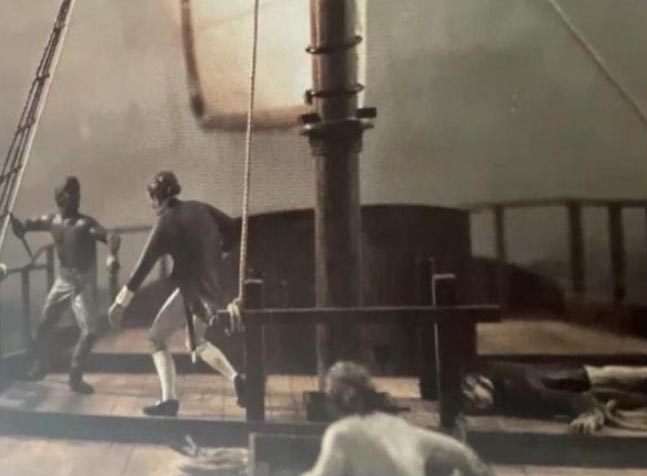
“On board schooner Polly com[mande]d by Caleb White & navigated by three men one of which was Jack a Negro the property of Henry White, part owner of s[ai]d schooner, loaded with corn pease and pork b[oun]d to W[est] Ind[ies] & sailed from Currituck 14 Feby 1780. On 16th inst. was boarded and taken by a British privateer call[e]d Fame of N. York com[mande]d by John Atkinson… We were immediately confined in irons and allowancd one gill of raw pease and one gill of water per day.“On the 19th we attempted to retake the schooner by first getting Jack out of irons but was discovered before we c[oul]d prosecute our design by some of the crew. They cons[is]t[ed] of a Prize Master & 4 hands. They immediately confined us below deck and lasht the feet of Jack to a stantion on the quarter deck his hands being bound where he lay 24 hours in a gale of wind or snow storm every sea making a breack over us. However he survived that afterward was loosed and permitted below with us. The reason of his usage was because he never w[oul]d consent to join them and attempting to get out of irons. However we ordered him to turn himself a[n] enemy of America. This had the effect we wish[e]d. They loosed him from his irons and he soon become their right hand man with promise of freedom and many rewards after arriving at [New] York but whenever he got an opportunity of speaking to us continued to tell us he was ready to assist us any moment in the recapture.
“On the 22[nd] the gale abating they were ab[ou]t making sail. My brother who was the Master got out of Irons gave the watch word and engaged the Prize Master. Jack immediately contrary to their expectations engaged two of them which he soon worsted having no weapon but a marlin spike. In the interim I got out of irons having procured a cullash [cutlass] but was much beaten before I got out after bloodshed on both sides we conq[uere]d them which we confined and carried in to Annapolis & delivered to Congress but by the wounds & frost Jack received he never walked a step for five weeks.” [16]
John Atkinson, captain of the vessel that captured the Polly, had moved from England to Boston, Massachusetts in 1767. [17] Like many loyalists, he relocated to New York at the outset of the revolution. [18] Atkinson was active as a privateer for much of the conflict, capturing American commercial vessels that included the Fair American (with a cargo of lumber) in 1779, the Three Sisters (with lumber and shingles) in 1781, and the Lydia (molasses, coffee, and rum) and Hazard (cod fish) in 1782. In each case, the captured ships were taken to New York. [19]
Jack, who suffered significant injuries in regaining control of the Polly, garnered little appreciation for his efforts from the vessel’s owner Henry White. Samuel Jasper wrote “after we returned home his Master abused him somewhat. Jack applyd to us for redress, upon which my brother bought him.”[20] Exactly when Caleb White purchased Jack from Henry White is unclear; no record of the transaction has been found.
After the war, brothers Caleb White and Samuel Jasper went into the shipping business for themselves. They jointly acquired a vessel they named Friendship, which is characterized in contradictory port records as having been either a sloop or a schooner. Each sibling separately captained the Friendship on trading voyages to the Caribbean. Caleb traveled to Hispaniola to retrieve a cargo of molasses, sugar, salt, coffee, and tea in 1784, and Samuel ventured to St. Bartholomew in 1786 for rum.[21]
Samuel Jasper and Caleb White both found wives in the mid-1780s, each apparently for the first time. Samuel married Lovey Mackey, a daughter of John and Jemima Mackey of nearby Mackey’s Island.[22] Caleb wedded Amey, the widow of John Simmons, after the latter passed away in the spring of 1785.[23]
Starting in 1786, North Carolina port records reflect Caleb White and Samuel Jasper as owners of a new vessel. The Resolution was a 26-ton schooner active in transporting shingles, corn, and potatoes north to Virginia, Maryland, New York, and Pennsylvania. It made at least twelve such trips between 1786 and 1789.[24] Samuel Jasper would later testify that Jack “commanded a schooner for me” in those years.[25]
In September 1787, in his final year of life, Caleb White transferred a small plot of marshland on Knott’s Island to his brother Samuel Jasper. That real estate is described in his deed of gift as being in the vicinity of Old Cross Way and Indian Creek, in the area where Jack is later documented to have lived.[26] What prompted the transfer of land is unknown.
Two days after giving land to Samuel Jasper, Caleb White signed his will. In it, he asked that Samuel continue to operate the schooner Resolution and divide two-thirds of any resulting profits between their mother Dorcas and Caleb’s widow Amey. Caleb’s last testament went on to say, "after negro Jack pays one hundred dollars to my executors, he may have his freedom." [27]
Making emancipation conditional on a payment by the concerned slave was an accepted practice at the time. The price of freedom was often prohibitively high. Enslaved individuals could rarely generate enough income over a lifetime, apart from the unpaid services they rendered their masters, to buy their way out of bondage.
After Caleb White passed away, Samuel Jasper continued to operate the Resolution for a few years. Jasper employed his brother-in-law John Mackey to serve as captain of the schooner on two trips to New York in 1788. The last recorded voyage of the vessel under Jasper’s ownership was in 1789.[28]
The 1790 federal census of Currituck County profiles Caleb’s widow Amey White heading a household of four whites and eight slaves.[29] She would marry again within a few years of the census, wedding widower James Phillips.[30] He was, as Caleb White had been, a mariner. Phillips served as a ship captain aboard commercial vessels sailing out of Port Currituck and Port Roanoke between 1784 and 1789. Among the schooners he sailed was one named Polly.[31]
Samuel Jasper and his mother Dorcas Jasper are listed in the 1790 federal census as heading separate Currituck County households. Samuel’s home is recorded as having three adult white males in it, together with five white females and five slaves. That profile is roughly consistent with details regarding his family included in his will written eight years later. His last testament made bequests to his wife, four daughters and one son, but does not account for the third white male in his home in 1790.
Dorcas Jasper, who also had five slaves in 1790, is recorded on the same census page in a home with two other white females.[32] The census taken a decade later provides age ranges for white females, which the 1790 enumeration did not. That later tally indicates the three whites in Dorcas’ home were each from a different generation, suggesting she may have been living with a daughter and granddaughter.
In May 1790, the Governor of North Carolina nominated Samuel Jasper to become the customs collector at Currituck Inlet. Governor Samuel Johnston did so reluctantly, as he was unconvinced of the necessity of the position. He forwarded a letter to George Washington conveying those doubts. That letter, written by Revolutionary War General Isaac Gregory of Camden County, North Carolina, outlined options to fill the post:
"Respecting a Surveyor for Currituck Inlet there is no person that lives on Crow Island but Herbert. I am told the people don’t like him. Mr. Samuel Jasper is the only man that I think will answer, who lives on Knot’s Island, within six or seven miles of the Inlet. I have sent Mr. Thomas Williams, who is Surveyor for Port Indian Town, down to the Inlet, he informs me that he can do all the business for both Ports himself by attending at Mr. Younghusband’s lands one day in a Week. [T]here are very seldom any other than coasting vessels which come in at that Inlet.” [33]
Thomas Williams, who told General Gregory that commerce at Currituck Inlet did not merit a dedicated customs official, was likely well known to Samuel Jasper. Williams was a post-war customer at John Cockton’s Currituck Courthouse tavern, and had served as captain of the schooner Harmony when it sailed from Port Currituck in January 1789 carrying staves to Charleston, South Carolina (the Harmony was owned at the time by Enoch Sawyer, but was later purchased by Jasper).[34] Williams is listed in the 1790 census adjacent to Samuel’s mother Dorcas Jasper.[35]
Despite Williams’ and Gregory’s doubts about the necessity of a dedicated customs official there, George Washington selected Samuel Jasper as the Currituck Inlet Surveyor on 25 May 1790. The United States Senate consented the following day, approving all nominees for the customs service in North Carolina. As part of that process, Gregory was appointed to a position in neighboring Camden County.[36]
In 1792, Samuel Jasper petitioned the North Carolina legislature to emancipate Jack. State laws governing slavery, which had grown increasingly restrictive, required General Assembly approval at the time to free an enslaved person. In his petition, Jasper recounted Jack’s exploits in overcoming loyalist privateers aboard the Polly during the war. He also reported “Jack hath paid the sum of $100 as directed by [Caleb White’s] will.”
Samuel Jasper closed his petition by extolling Jack’s character, noting “the said fellow behaves himself well, [is] honest and industrious, is very mannerly to all, and as commanded a schooner for Me five years, is intrusted by Mr. Daughty with Many Hundred Pound ever year.”[37] The referenced “Mr. Daughty” appears to have been a member of a local seafaring family whose surname can also be found in local records spelled as Doughty, Dowdy, and ODowdy. Edward Doughty, Jr, who had extensive Currituck County land holdings at both Moyock Mill and the Great Swamp, owned the schooner Dolphin and a sloop called Polly in the mid-1780s. Whether the latter vessel was the Polly that previously belonged to Henry White is not known. William Doughty/Dowdy, of unproven relation to Edward, served as Captain of the Dolphin on trips to Edenton, North Carolina and Baltimore, Maryland in 1789.[38]
Representative John Hamilton of Edenton, North Carolina presented Samuel Jasper’s petition to the state legislature. It was then combined with other emancipation proposals in a single General Assembly private act in December 1792. The resulting law granted freedom to ten persons of color across the state, and specified the names by which each was to be known henceforth. “Jack, the property of the late Caleb White, of the county of Currituck” was assigned the name John Jasper White.[39] A decade separated his wartime heroism from his emancipation. Henry White, the man who sold Jack to Caleb White at the conclusion of the American Revolution, was nearing the end of his life when his former slave was freed. After signing his will in January 1792, Henry sold Samuel Jasper three acres of land near the latter’s “dwelling house,” in return for Jasper paying White’s son Samuel sixty silver dollars.[40] Their deed is one of Henry White’s final appearances in the historical record - his last testament was recorded by court officials in June 1794.[41]In January 1797, Samuel Jasper witnessed “John White orphan of Henry White deceased” commit to provide former slave John J. White “one acre of land and give release for four acres for the space of fifteen years…when John White comes of lawful age.”[42] Two years later, in January 1799, John White executed two deeds as promised, selling five acres of land on Knotts Island to John J. White for a total of 120 dollars.[43]
Samuel Jasper, “considering the mortality of the body,” signed his will in August 1798. In it, he made bequests to his wife Lovey and their five children. He expressed his wish that “my Wife… make all the profits she can by hiring out the negroes [and] sailing or selling Schooner Harmony for discharging my debts and supporting my children during her widowhood.” Perhaps reflecting on his own experiences as an orphan, he dictated that his son Samuel “never…come under a Father-in-law or any man save either of my executors.” [44]
The elder Samuel Jasper’s 1798 last testament identified his executors as his brother-in-law Captain John Mackie and Colonel Andrew Duke. . How he came to know Duke is unclear. Duke, a Revolutionary War veteran, was a fellow mariner. He sailed to New York and Baltimore as the captain of schooners a dozen times between 1784 and 1789.[45] Duke represented Currituck County at the 1789 North Carolina convention held at Fayetteville to ratify the United States constitution. He also served in the North Carolina General Assembly 1789-1790, and 1793-1795.[46]
Although Samuel Jasper signed his will two years earlier, he was still alive at the time of the 1800 census. That enumeration recorded the adult white male and female in his home as both being in the age range 26 to 44, and noted the presence of five younger whites matching the genders of the children identified in Samuel’s last testament. The census also acknowledged eight blacks in Samuel Jasper’s household.[47]
Federal officials did not require census-takers record the genders or age ranges of non-whites. Authorities did, however, mandate determining the overall number of “all other [non-white] free persons, except Indians.” They further required conducting a separate count of slaves. Currituck County census-taker Nathan Tatem took some liberties with the categories provided by federal authorities. Rather than record “other free persons” and “slaves,” he provided counts of “Molatoes” (mulattos) and “Negro Slaves.” His choice of words reflected an environment where free blacks were predominantly of mixed race, and emancipation was often an indication of slaveholder paternity. In the statistical summary appended to the final page of his report, he reported 116 “persons of color” (a term used interchangeably at the time with “mulattos”). They constituted 1.67 percent of the county’s 6,946 inhabitants.[48]
Presumably not included in the census count of enslaved individuals in Samuel Jasper’s household was a man he had freed earlier that year. A carpenter known as “Old Peter” is the only person, apart from John Jasper White, who Samuel Jasper is known to have emancipated. In doing so, Samuel reserved the right for the Jasper family to continue to call upon Peter to do carpentry work:
“Know all men by these presents I Samuel Jasper…having duly considered the principals of Slavery do Fully & Entirely and Absolutely for the Respect I Bear Old Peter Carpenter Emancipate and Set him free to…act as a free man at all times and Places free from any Incumberance of or by my assigns except…when ever me or my heirs shall want any kind of houses built or Plantation work as to wooden repairs of any kind he shall at all times faithfully perform it in preference of any one all the days of his Life…” [49]
The 1800 census lists John Jasper White’s household adjacent to that of John White (son of Henry White). That enumeration shows three “negro slaves” living in the emancipated White’s home, but no free men. The inclusion of his name on the census was recognition of John Jasper White’s status, although the census-taker was apparently reluctant to fully acknowledge it. The slaves in his home may have been his wife and children. Freed men sometimes managed to purchase their family members, but could not reasonably hope to legally free them.
A North Carolina law passed in 1801 imposed a fee of £100 to emancipate a slave, while maintaining the requirement for prior approval from the state legislature.[50] Various enhanced impediments to manumission were enacted at the outset of the nineteenth century, prompted in part by international developments. Slave revolution raged in the French colony of Santo Domingo between 1791 and 1803, eventually resulting in the creation of the independent country of Haiti. Fear spread in some circles that a revolutionary contagion could spread north from the Caribbean to slave populations in the United States.[51]
Recurring rumors of impending slave revolts in the Albemarle Sound region of North Carolina were fueled by the coerced testimony of people of color against one another. A slave named Mingo told court officials in early 1802 that an “outlaw” maroon by the name of Tom Copper, who lived in the Great Dismal Swamp, was masterminding a regional uprising “to kill the white people.” Authorities wasted no time in responding to the perceived threat. Newspapers reported:
“A gentleman who last week passed through the lower counties of North Carolina informs that the people in general are much alarmed at the conduct of the negroes; that nightly patrols of horse and foot are regularly kept, and that numbers of the deluded wretches are in confinement.
“On Saturday the 15th inst. [May 1802] there were two negroes tried at Camden [County], found guilty, and executed on the evening of the same day. At Currituck [County] two more were hanged on Wednesday last and it is expected that many will suffer at Elizabeth City, the jail of which place is full of negroes, whose trials come on this week.”[52]
Similar executions of enslaved men were reported in Princess Anne County, Virginia, which bordered Currituck County, North Carolina to the north. Months after those killings, the Weekly Raleigh Register admitted that the alarm over alleged slave revolt conspiracies “is now generally allowed to have been greater than the occasion warranted.”[53] That realization came too late for those who lost their lives in the aftermath of false accusations.
Within a year of the executions described above, John J. White, “very sick and weak in body,” acknowledged his will with a mark. Sixteen years had passed since the death of Caleb White, and less than two years since Samuel Jasper was laid to rest. John J. White’s last testament identified a wife named Rose, and referred to his children without revealing their number or names. In his will, White specified the property his wife was to inherit and designated the executors of his estate.
“I give and bequeath unto Rose my dearly beloved Wife all my land and house one bed and one horse…two cows bed furniture one chest and all my household furniture during her widowhood the Schooner and remainder of my estate to be sold and my debts paid and the over plus to be equally divided among my children. I likewise constitute make and ordain my only and sole executor[s] of this my Last Will and Testament James Phillips and John Williams…” [54]
The executors designated in John J. White’s last testament were white men with the necessary legal standing in court. Each was a seafaring slaveholder tied to the Knott’s Island community by family connections. James Phillips was, as noted, the husband of Caleb White’s widow. John Williams was a neighbor of the White and Jasper families.[55] Anthony Frame and David Jones, who both witnessed the will, had similar backgrounds.[56] Frame’s wife Julia was a daughter of Henry White.[57] Jones, a mariner, had moved to the area from Cumberland County, New Jersey “in his early manhood.”[58]
Seventeen months after John Jasper White signed his will, a Currituck County court granted him permission to operate an ordinary (tavern) “at his own dwelling house.” “Colonel” John Williams and Caleb Etheridge provided the required security for him to do so.[59] In seeking that authority, White may have been seeking a means of income at a point in life when he was no longer able to perform physically demanding labor.
When officials recorded John J. White’s will in May 1805, John Williams appeared in court to qualify as executor of the deceased’s estate. Judges ordered Williams to sell the “parishable” (perishable) part of White’s estate and report the results at the next court session. [60] No record of a corresponding estate inventory has been found.
John J. White’s family disappears from the historic record after his death; what little is known of his wife and children does not suffice to confirm their identities in subsequent documents. The only basis for passing freedom from one generation to the next under the laws in force at the time was the status of the mother; if Rose was considered chattel, her offspring would also have been enslaved. No person of color with the White surname is recorded in the region in the decades following John J. White’s death. Henry White’s son John, who sold John J. White land in 1799, purchased an enslaved woman named Rose in October 1809. Charles Williams, of unknown relation to Currituck Jack’s estate executor John Williams, sold her to White, along with ten other enslaved individuals.[61]
Despite, or perhaps because of, our imperfect understanding of his life, “Currituck Jack” lives on in legend. His story is not one kept alive by family members; it is not known if he has living descendants. In the nineteenth century, some whites appear to have appreciated his history as that of a slave loyal to his masters.[62] People today celebrate him as an American patriot, and emphasize his achievements as a man of color in an inequitable society.[63] Through the fog of interpretation, misinformation, and fable that surround him, one core truth shines through – he led a remarkable life.
FOOTNOTES
[1] John L. Cheney, Jr, editor, North Carolina Government 1585-1979, A Narrative and Statistical History (1981), pp. 38, 41, and 43
[2] Henry White’s Currituck County, North Carolina will was signed on 22 December 1751 and recorded in court on 10 September 1754. Images of his last testament can be accessed on ancestry.com under North Carolina, U.S., Wills and Probate Records, 1665-1998, Not Stated, Wills and Court Minutes, 1712-1758, images 184-187 of 649.
[3] Henry White served in the North Carolina legislature in 1761-1762, 1764, 1768, 1771, and 1773-1774. See State Archives of North Carolina, Minutes of the Lower House of the North Carolina General Assembly, November 03, 1762 - December 11, 1762, Volume 6, p. 893. Also see Cheney, op. cit., pp. 47, 49, 51-53, 55. For proof of the identity of Henry White’s wife, see the 28 October 1770 Currituck County, North Carolina will of Mary Mackie (widow of John Ansell) which identifies Letisha White as her daughter and John and Caleb Ansell as her sons. Also see the 7 January 1792 Currituck County will of Henry White, which confirms his wife was named Letisha.
[4] For an image of the quoted March 1769 Currituck County, North Carolina power-of-attorney between George May and Henry White, see familysearch.org film 007513405, image 737 of 751. That document was witnessed by John Woodhouse and Samuel Jarvis. Two years later, May would purchase land in North Carolina from Luke Lamb. See Currituck County, North Carolina Deed Book 2, pp. 332-333.
[5] See Currituck County, North Carolina Deed Book 6 (p. 184), Deed Book 7 (p. 135), and Deed Book 11 (p. 70).
[6] Genealogist Melinda J. Lukei erred in her entry regarding the White family in Jo Anna Heath Bates, editor, The Heritage of Currituck County, North Carolina (1985), pp. 448-449. She asserted that Henry White (-circa 1754) “was married three times. He married Ledia Church, daughter of Joseph and Julanna Church….Henry's second marriage was to Esther, daughter of Cornelius Jones and Elizabeth. Esther was also the widow of Nathaniel Denby….The third marriage of Henry White was to Dorcas, who married Thomas Jasper after the death of Henry.” White’s will does not identify his wife by name. An entry in Princess Anne County, Virginia Deed Book 8, p. 142, dated 15 February 1757, makes clear that Esther survived Henry White. That document states: “Esther White, widow & relict of Henry White, decd. of North Carolina to Joseph White, son of the said Henry White…for £8 her one third dower rights in a plantation and tract of land on Nanny’s Creek in Princess Anne County which Henry White decd. bequeathed to Joseph White.” The bequest referenced in the 1757 Virginia deed matches Henry White’s 1751 North Carolina will, which proves Esther was Henry White’s widow (and Dorcas Jasper was not). Lukei’s error is perpetuated in John A. Brayton, Annotated Transcriptions of Colonial North Carolina Wills (2011), p. 256, which cites her contribution to The Heritage of Currituck County.
[7] See reference to “my Brother Samuel Jasper” in the Currituck County, North Carolina will of Caleb White, signed 7 September 1787 and recorded 20 July 1788. Also see Samuel Jasper’s reference to his “Brother Caleb White” in the 14 December 1792 legislative petition for the freedom of Jack (State Archives of North Carolina, Petitions, November 1792 - January 1793; Box 3).
[8] Thomas Jasper signed his Currituck County, North Carolina will on 29 September 1763, witnessed by Henry White, Joshua White, Thomas Bedford, and Esther Bedford. There is no date given in the associated court record indicating when his death was reported to officials. An image of Jasper’s will can be accessed on familysearch.org, under North Carolina Probate Records, 1735-1970, Currituck, Wills, 1761-1792, Vol. 1, image 14 of 174. That last testament includes a bequest to Samuel Jasper of a plantation on “Blunt Creek,” an apparent reference to Blount’s Creek in Beaufort County, North Carolina, which flows through wetlands into the Pamlico River.
[9] An image of the Edenton, North Carolina 1770 court summons identifying Dorcas Jasper as the guardian of Lydia and Caleb White can be accessed on familysearch.org under Estates Records: Edenton District: North Carolina Probate Estate Case Files, Image Group Number: 004763700, images 1,613-1,615 of 1,933. In the journal article Currituck Jack, in American History Illustrated (February 1981), p. 18, Thomas C. Parramore mistakenly identifies half-siblings Samuel Jasper and Caleb White as brothers-in-law, an assumption apparently based on their different surnames. As documented above, the two were raised by their common mother.
[10] In December 1772, Dorcas Jasper had her son Caleb White retrieve her order from John Cockton’s store. Her daughter Lydia White did the same for her in May 1773. Samuel Jasper picked up a teapot for her in December 1775, in conjunction with attending a militia muster. He separately purchased seven pounds of tobacco from Cockton that same month. See State Archives of North Carolina Record ID: PC.AB.78.1, John Cockton’s Day Book and Ledger, entries for 17 October, 21 October, 4 November, and 2 December 1772; 5-6 May, 25 June, 3 July, 7 and 14 August 1773; 28 February and 6 December 1774; June 1776 (day not specified); and 4 December 1783.
[11] State Archives of North Carolina, General Assembly Records, GA 30.1. Their respective property values in 1779 ranked Henry White 8th and Dorcas Jasper 114th of 583 county heads-of-household.
[12] Letters written by William Ferebee and John Humphries in 1779 regarding privateers active along Currituck County’s coast are held at the State Archives of North Carolina, General Assembly Session Records, May 1779, Box 1. They can be accessed online at digital.ncdcr.gov/Documents/Detail/miscellaneous/828831? item=828883 (images 9-12 of 16).
[13] State Archives of North Carolina, B2F24, Depositions of James Simpson and Jonathan Bonney, dated 16 March 1779.
[14] Folklore describes Jack as a physically imposing man (see Charles H. Whedbee, Outer Banks Mysteries & Seaside Stories (1978), pp. 44-66, and Thomas C. Parramore, Currituck Jack, in American History Illustrated (February 1981), pp. 18-19 and 49). Nothing in the historical record confirms such accounts.
[15] Charles Christopher Crittenden, Ships and Shipping in North Carolina, 1763-1789, in The North Carolina Historical Review, Vol. 8, No. 1 (January 1931), pp. 1-2. Crittenden notes that of “schooners and sloops clearing from Port Roanoke during the period…, sixty-three made coasting voyages, and eight went to the West Indies.” More comprehensive records than were perhaps available to Crittenden indicate eight schooners left Port Roanoke crossing the Atlantic to Europe or Africa during the period covered in his journal article. See State Archives of North Carolina, Port Records of the Treasurer’s and Comptroller’s Papers which can be accessed at: archaeology.ncdcr. gov/programs/uab/education/portrecords.
[16] State Archives of North Carolina, 14 December 1792 Petition of Samuel Jasper, Executor of Caleb White, held under General Assembly Record Group, Session Records, Session of November, 1792 - January, 1793 (Record ID: 66.8.66.12.4). Capitalization within the quoted text has been adjusted to more closely match modern sentence norms for ease of reading. Spelling within the quoted text is consistent with the original. Jasper’s reference to having delivered the captured loyalists to Congress should not be taken literally, as the Continental Congress did not meet in Annapolis in 1780. He apparently meant to convey that the prisoners were turned over to local authorities.
[17] See the post-war memorial for compensation submitted by John Atkinson to British authorities, as well as the supporting letter signed by Francis Green. These can be accessed on ancestry.com under UK, American Loyalist Claims, 1776-1835, AO 13 (images 528 and 540). Samuel Jasper’s petition used a spelling variation of Atkinson’s surname more familiar to Currituck County residents. A John “Adkinson” served with revolutionary forces in northeast North Carolina as a member of White’s Company of Colonel Gideon Lamb’s 6th Regiment.
[18] John Atkinson was among the 300 loyalists who had fled the colony named in the September 1778 Banishment Act of the State of Massachusetts.
[19] British National Archives, Vice Admiralty Court, Captured Ship Records, HCA 32/328/4 (the Fair American), HCA 32/462/17 (the Three Sisters), HCA 32/392/29 (the Lydia of Providence), and HCA 32/350/27 (the Hazard).
[20] State Archives of North Carolina, 14 December 1792 Petition of Samuel Jasper, Executor of Caleb White, held under General Assembly Record Group, Session Records, Session of November, 1792 - January, 1793 (Record ID: 66.8.66.12.4).
[21] State Archives of North Carolina, Port Records of the Treasurer’s and Comptroller’s Papers.
[22] The date of Samuel Jasper’s marriage to Lovey Mackey (a surname also recorded in local documents as “Mackie”) is undetermined. On 26 April 1788, John Mackie Sr executed a deed giving four female slaves, his horse “Genius,” and half of his cattle, hogs, and sheep to his daughter Lovey Jasper and granddaughter Sarah. Less than a year later, on 2 March 1789, he gave five hundred acres, five slaves, two horses, his household furniture and half of his cattle hogs and sheep in trust to his namesake son John Mackie. On 27 February 1790, John Mackie Sr’s widow, Jemima Mackie executed a deed giving John Mackie Jr the five hundred acres that held in trust for him. Samuel and Lovey Jasper witnessed the deed. See Currituck County, North Carolina Deed Book 6, pp. 6, 15, 56-57, and 68.
[23] John Simmons’ Currituck County, North Carolina will, identifying his wife Amy, was signed in January 1785 and recorded in court in April that year. An image of it can be accessed on ancestry.com under North Carolina, U.S., Wills and Probate Records, 1665-1998, Currituck Wills, Vol 1-2, 1761-1810 (image 110 of 425). For proof that Simmons’ widow was the same Amy who married Caleb White, see State Archives of North Carolina, Edenton District Superior Court Estates Records 1756-1806; microfilm C.201.1905675. In 1791, “Malachi Jones was appointed...to settle the accounts of Samuel Jasper & Amey White, exrs of the Last Will of Caleb White decd. Amey produced a note Caleb gave her [when] she was the Widow of John Simmons deceased to the amount of Fifty pounds.” Amey’s maiden name has not been determined.
[24] State Archives of North Carolina, Port Records of the Treasurer’s and Comptroller’s Papers.
[25] Affidavit of Samuel Jasper dated 17 November 1792 in Indian Town, Currituck County, and submitted to the North Carolina legislature as part of the 14 December 1792 petition to emancipate Jack (cited above).
[26] Currituck County, North Carolina Deed Book 5, p 325. Deed dated 5 September 1787, witnessed by William Lamb and Samuel Jarvis, and registered in court on 14 July 1788.
[27] Currituck County, North Carolina Will Book 1, p. 232; the will of Caleb White, signed on 7 September 1777 and registered in court on 20 July 1788. Caleb White’s wife Amy and brother Samuel Jasper were designated co-executors of his will.
[28] State Archives of North Carolina, Port Records of the Treasurer’s and Comptroller’s Papers.
[29] The 1790 federal census of Currituck County, North Carolina, p. 279. Amey White is listed in that enumeration immediately above Thomas Younghusband. The other whites in her household were profiled as two males under the age of sixteen, and one female (age range not given). The people of color in Amey White’s household presumably included Jack. Later records reveal he had a wife and children (see Currituck County, North Carolina Will Book 2, p. 266). It is not known when he married, or if his spouse and offspring lived in the same household.
[30] For proof of the marriage of Caleb White’s widow Amey to James Phillips, see Currituck County, North Carolina Deed Book 8, p. 71. In August 1797, “James Phillips & wife Amey of Currituck County sold…a tract of land on Knotts Island…this being the…plantation that [John] Ansell…conveyed to Amey White now the wife of said James Phillips.” James Phillips had previously been married to a woman named Mary, who was identified as his wife in August 1783 in Currituck County Deed Book 6, p. 50.
[31] It is not known if the schooner Polly that James Phillips sailed in 1784 and 1789 was the same vessel by that name briefly captured by privateer John Atkinson in 1780, although Phillips’ area of operation suggests the possibility. Phillips also sailed sloops called Dove and Industry. He was active along the Atlantic Seaboard, as well as in the Caribbean. See State Archives of North Carolina, Port Records of the Treasurer’s and Comptroller’s Papers.
[32] The 1790 federal census of Currituck County, North Carolina, overwritten with the page number 290. Seventeen lines separate the entry regarding Samuel Jasper (who is listed immediately following William Dudley) from the one pertaining to Dorcas Jasper. James Ansell, John Mackey, and four White heads of household (Henry Sr, Henry Jr, Patrick, and Solomon) are listed on the facing census page (number 289).
[33] National Archives Records Administration, Letter to George Washington from Samuel Johnston, dated 1 May 1790. An image of the letter can be accessed at founders.archives.gov/documents/Washington/05-05-02-0236. Note that the transcription of the letter posted by the National Archives contains an error. The reference in the letter to “Mr. Younghusband’s lands” is erroneously transcribed as “Mr Younghers lands.” Thomas Younghusband sold local real estate on 10 February 1792 (Currituck County, North Carolina Deed Book 6, pp. 206-207), prior to his death in late 1792. The Herbert “people don’t like” referenced in the letter may have been Charles Herbert, who appears in John Cockton’s daybook on sixteen occasions between 1784 and 1788 buying alcohol. No Herbert appears in the 1790 census of Currituck County.
[34] State Archives of North Carolina, Port Records of the Treasurer’s and Comptroller’s Papers. See reference to the schooner Harmony in the will of Samuel Jasper, signed 23 August 1798 and recorded 14 June 1801 in Currituck County, North Carolina Will Book 2, p. 189.
[35] Two men named Thomas Williams are listed in the 1790 federal census of Currituck County, North Carolina. The one who was not Dorcas Jasper’s neighbor is identified in that enumeration and other documents as Thomas Pool Williams. He represented the county at the 1789 North Carolina convention to ratify the United States constitution.
[36] Journals and Records of the 1st United States Congress, Executive Journal, p. 44.
[37] State Archives of North Carolina, Petition of Samuel Jasper, Executor of Caleb White, to the North Carolina General Assembly, contained in Session of November 1792-January 1793: Petitions concerning emancipation, GASR November 1792 - January 1793; Box 3. Capitalization within the quoted text has been adjusted to match modern standards.
[38] See Currituck County, North Carolina Deed Books 4 and 6, pp. 14 and 35-36 respectively. Also see State Archives of North Carolina, Port Records of the Treasurer’s and Comptroller’s Papers.
[39] Acts of the General Assembly of the State of North Carolina, Passed During the Session Held in the Years 1791, 1792, 1793 And 1794 (1795), Chapter XXXVIII (An Act to Emancipate the Persons Therein Named), p. 20.
[40] Currituck County, North Carolina Deed Book 7, p. 135. The deed was signed 30 August 1793 and registered 19 March 1795. See the same deed book, pp. 127-129 for a plat sketch illustrating the division of lands Henry White left his sons Caleb, John, and Solomon White.
[41] Henry White’s Currituck County, North Carolina will was recorded and examined on 23 June 1794.
[42] Currituck County, North Carolina Deed Book 8, p. 22. The deed was signed 4 January 1797 and registered on 10 October that same year. Also see Currituck County, North Carolina Court Minutes (May-August 1800 session), p. 41a.
[43] Currituck County, North Carolina Deed Book 3, pp. 185-186. The first deed was for one acre and the second deed for four acres, paralleling the language in the original 1797 bond.
[44] The will of Samuel Jasper, signed 23 August 1798 and recorded 14 June 1801 in Currituck County, North Carolina Will Book 2, p. 189.
[45] Andrew Duke was captain and owner of the 10-ton schooner Dolphin on ten trips to Baltimore, Maryland between 1784 and 1789, carrying shingles and corn north. His vessel is not to be confused with the 20-ton Dolphin operated by Edward Doughty/Dowdy during the same period. See State Archives of North Carolina, Port Records of the Treasurer’s and Comptroller’s Papers.
[46] Massengill, op. cit., p. 18, and Cheney, Jr, op. cit., pp. 223-224, 229, 231, and 768.
[47] The 1800 federal census of Currituck County, North Carolina, p. 401 (page number overwritten on form). Samuel Jasper’s household was listed in the 1800 census next to his mother Dorcas Jasper’s home. Her household included three white females (one each in the age ranges 45+, 26-44, and Under 10). They resided with six persons of color.
[48] Nathan Tatem’s handwritten column headings in the 1800 census varied slightly from one page to the next. On some pages he wrote “Negro Slaves” and on others he substituted the header “Negrows.” Although Tatem reported 116 “persons of color” on the summary page, that number was later corrected to 114. Tatem’s math was off by a net overcount of 18 across all categories, according to corrections on the summary page of his report.
[49] State Archives of North Carolina, Microfilm Reel C.030.30001 (Currituck County Court of Pleas and Quarter Sessions Minutes, 1799-1868, pp. 41-41a). This record can be accessed at familysearch.org film 008356861, image 94. Spelling within the quoted text is consistent with the original.
[50] For more on enhanced impediments to manumission, see Rosser H. Taylor, The Free Negro in North Carolina (1920), pp. 8, 10, 13, and 16. Rosser’s work was written as a Master’s thesis at the University of North Carolina.[51] Authorities in Bertie County, North Carolina sent urgent correspondence to counterparts in neighboring Martin and Halifax counties in early June 1802, also reporting the discovery of slaves plotting a region-wide rebellion. For more on authorities’ responses to perceived slave plots in southside Virginia and the Albemarle Sound region of North Carolina, see: David Leatherwood, Dancing on the Dan, The Williams Family of Pittsylvania County, from the Revolution through the Civil War (2016 manuscript), pp. 77-84, and Leatherwood, Moving On, Barcos and Related Barkers (1783-1829), (2020), pp. 37-39.
[52] The New York Evening Post edition of 31 May 1802, p. 3 (subtitled “From a Norfolk paper of May 23”). Related articles can be found in 24 May 1802 edition of the same newspaper (p. 3), the 25 May 1802 editions of the New York Poughkeepsie Eagle (p. 2) and the Philadelphia Gazette of the United States (p. 4), and the 26 May 1802 edition of the Pennsylvania Lancaster Intelligencer (p. 3). Purported plot leader Tom Copper is identified as Tom Cooper is some press accounts.
[53] The Weekly Raleigh Register edition of 6 July 1802, p. 3.
[54] Currituck County, North Carolina Will Book 2, p. 266. John Jasper White’s will was signed 28 March 1803. When it was exhibited in court in May 1805, John Williams qualified as estate executor (Currituck County, North Carolina Court Minutes, May Term 1805, p. 141). Court authorities ordered him to sell White’s land eight months later (Currituck County, North Carolina February Term 1806, p. 217).
[55] Port Currituck records show John Williams as the owner of the schooners Abiah and Jane (1784-1785) and Two Brothers (1785-1786). The 1790 federal census of Currituck County, North Carolina lists the households of “Captain” John Williams, Thomas Williams, Dorcas Jasper, and Samuel Jasper all in proximity to one another. National Archives Records Administration (NARA), Revolutionary War Pensions (M804/Record Group 15), Pension Application W18436 regarding John Williams includes a sworn statement by Thomas Williams confirming he was John’s brother, and that John had married Abiah Morse of Princess Anne County, Virginia in 1772. Also see NARA Compiled service records of soldiers who served in the American Army during the Revolutionary War, 1775-1783 (M881/Record Group 93). “John Williams” and “Captain Williams” appear among tavern patrons in John Cockton’s daybook (op. cit.).
[56] Andrew Frame is listed in the 1800 federal census of Currituck County, North Carolina with nine slaves in his household, and David Jones with five. See. pp. 141 and 155 (stamped) of that census.
[57] Currituck County, North Carolina Deed Book 11, pp. 68-70, identifies “Anthony Frame and Juley his wife” among the heirs of Henry White.
[58] See discussion of David Jones’ origins in the obituary of Dr. Enoch D. Ferrebee published in The Oxford Torch-Light edition of 18 April 1876, p. 2, and in the Raleigh Christian Advocate edition of 26 April 1876, p. 2 (identical text). See Currituck County, North Carolina Deed Book 9, pp. 168-169, for documentation of “David Jones, Mariner,” selling Thomas Bray an enslaved nine-year-old boy named Lewis in 1806. Anthony Frame witnessed the transaction.
[59] The minutes of the 31 August 1804 Currituck County court session that granted John Jasper White permission to operate an ordinary can be accessed on familysearch.org film 008356861, image 444 of 578. Colonel John Williams and Caleb Etheridge provided £115 security.
[60] Currituck County, North Carolina court minutes, 28 May 1805 and 27 February 1806, pp. 141 and 217. Those records can be accessed on familysearch.org film 008356861, images 476 and 516.
[61] Currituck County, North Carolina Deed Book 11, p. 1, deed dated 3 October 1809. White paid $1,000 for the “parcel” of human chattel. The transaction was witnessed by William and Stewart Williams.
[62] See the 16 June 1874 edition of The Norfolk Virginian. That published account erroneously refers to “two brothers named Jasper,” rather than half-brothers Samuel Jasper and Caleb White. It also asserts the Polly was intercepted trying to resupply beleaguered continental forces at Charleston, South Carolina. Samuel Jasper’s legislative petition, op. cit., indicates the Polly was carrying cargo to the West Indies when captured, and says nothing of Charleston.
[63] See Paul Nielsen’s article Currituck plans to honor Revolutionary War hero Currituck Jack, in the Perquimans Weekly, 28 December 2022.

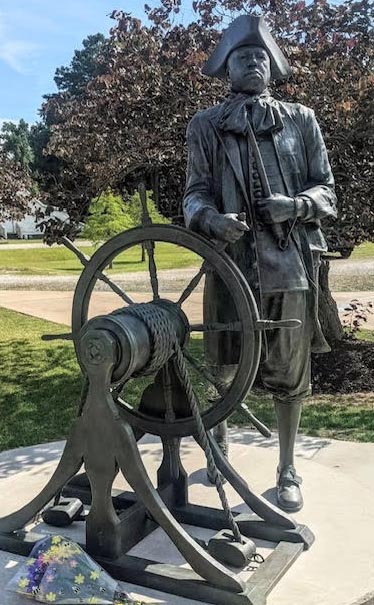
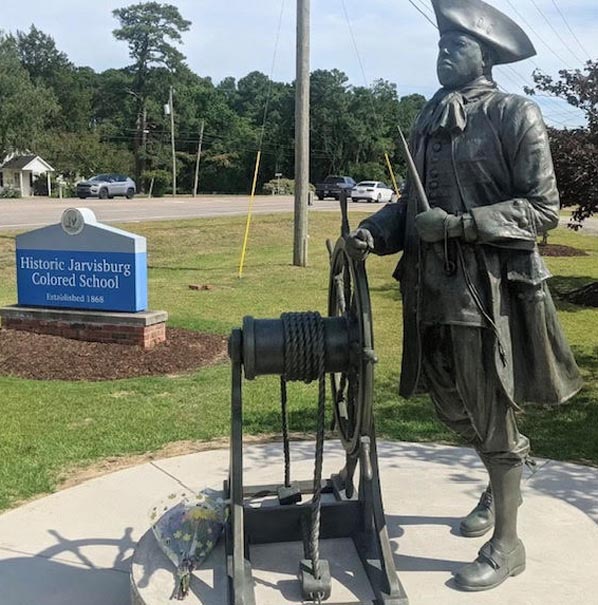
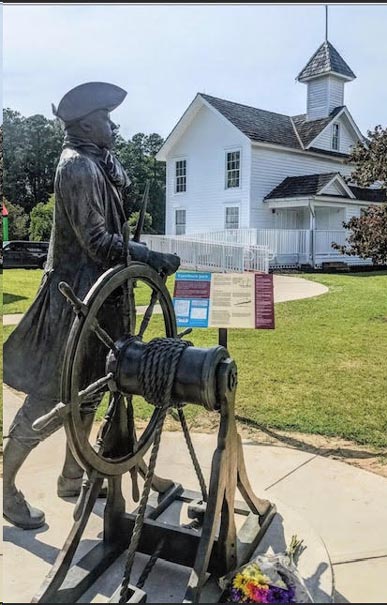
Photos from Juneteenth 2026
Photos by
Doris Ann Younts and Currituck Jack
images sculpted by Stephen Hayes
|
|
|
© 2026 Kay Midgett Sheppard